A young woman is murdered in a boarding house, and nobody knows what to do about it. The volunteer watchman who patrols the streets of this placid college town has no idea how to investigate a serious crime and the private bounty hunters the girl's family has hired to catch the killer employ methods that are questionable, at best.
What Cambridge needs is a hero, and, in a situation such as this, it's very easy for a gentleman with a romantic disposition to mistake himself for one.
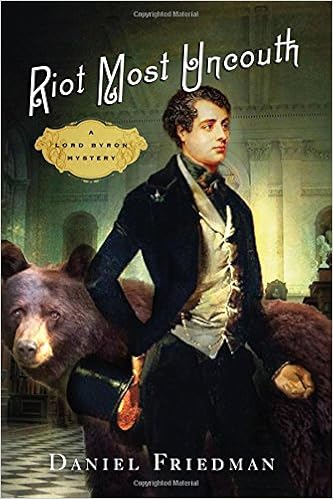
19 year-old Lord Byron, the outlaw poet, is a student at Trinity College, though he can only be described as a "student" in the loosest sense of the word: He rarely attends class and, instead, spends his time day-drinking, making love to faculty wives, and feeding fine cuisine and expensive wine to the bear he keeps as a pet.
Catching a killer seems like a fine diversion, however, and Byron decides that solving the crime must take precedence over other, less-urgent matters such as his failing grades and mounting debts.
And it's pretty good: "Besides adroitly placing the major plot twists, Friedman manages to make one of the most obnoxious leads in recent memory oddly endearing and even sympathetic." - Publishers Weekly
"100 percent swagger... Inspired, hilarious lunacy" - Library Journal "Even though the crime is grisly and Byron’s debauchery distinctly wanton, Friedman laces the narrative with comic moments, wry observations on noble privilege, and excellent plot turns." -Booklist "you’ll find yourself intrigued and then committed to Friedman’s lavish, over-the-top plot and larger-than-life characters." -BookPage Go buy it!
“Alternately humorous and moving sequel . . . The howdunit of the 1965 crime will please Golden Age puzzle fans.” —Publisher’s Weekly (starred review)
"Enjoy the plot, which even has a locked-room mystery packed into it. Savor the resonant prose as a reminder of how flabby much best-seller writing has become. Delight in Buck’s deadpan humor, but don’t fall for it. No codger cuteness here; his nastiness can shock." —Booklist "A must-buy" -Library Journal
“Daniel Friedman has done it again—only better.” —Michael Sears, bestselling author of Black Fridays
“Don’t Ever Look Back is a funny, smart, and vibrant work of crime fiction. Good luck finding anything more from a novel this year.” —Wiley Cash, New York Times bestselling author of A Land More Kind Than Home and This Dark Road to Mercy “Daniel Friedman takes the considerable momentum from his Macavity-winning debut novel Don't Ever Get Old and builds on it for Buck Schatz's newest turn, Don't Ever Look Back. Friedman's sophomore outing is darker, grittier, and more political (but just as funny) as his first. It not only lives up to, but indeed surpasses, all expectations for a sequel.”—Susan Elia MacNeal, New York Times bestselling author of the Maggie Hope series
How dreadfully embarrassing!
I seem to have misinterpreted your gracious invitation, for I have
arrived at this event with accouterments completely inappropriate for the
afternoon’s planned activities. What an unfortunate faux pas. I certainly have egg on my face, don’t I? I wonder if any of the other attendees might
have spare equipment which they could loan to a poor, embarrassed bungler. They do not?
Perhaps we could reschedule?
I think, under the circumstances, this comic little
misunderstanding was reasonable, and I hope it can be easily resolved. You see, the other day in the saloon, when
you and I were both quite tipsy from the barkeep’s fine moonshine whiskey, and
we were amorously eyeing the same twenty-five cent harlot. As an object of lust, she wasn’t terribly
compelling, but there was a real fire to her spirit; a certain irresistible joie de vivre, once you looked past her
lazy eye and her missing teeth and those strange, oozy yellow-green sores. And, as both of us found our entertainment
options limited by the influence of the current macroeconomic tumult upon our
personal finances, and since neither of us was in a patient mood, the question
of who might have the first roll with her became a topic of some dispute.
As discussions became heated, I called you a dust-sucking
sheep rapist, and you intimated that I was a worn-out drunk with a tendency to
crawl upon my yellow belly. I expressed
my belief that your cross-eyed mother must have been kicked in the belly by a
mule to produce offspring as deformed and stupid as yourself. You claimed that my horse looked mangy and
accused me of feeding it improperly and neglecting its grooming. Then
you spat a thick brown liquid upon the floor, and I spat the juice from my own terbaccky
chaw upon your newly-shined boots. You
took grave offense.
"Why don't you come over here and say that?"
At that point, negotiations broke down.
Ever helpful, I suggested that the dispute might be
satisfactorily resolved were we to make something of it. To illustrate the point, I smashed a whiskey
bottle on the bar, and menaced you with its jagged edge. Initially, you seemed amenable to exploring
such mechanisms to satisfy our disagreement. However, you felt that the timing
was inopportune for such activities; it was more to your convenience to
reconvene today, at high-noon. I found I
was available, and we made our date.
Based on the tone and context of our previous exchange, I
had believed that you had invited me here for purposes of engaging in barroom
brawling and fisticuffs, and I came equipped with this here Bowie knife, and a
vague plan that I might jam it into your kidneys. Or, you know, cut your throat, or stab you in
the eye. But you can imagine my surprise
to learn that you had actually intended to invite me to duel with pistols. And here I am, without my sidearm or
bandolier.
So, we’re left with a conundrum. If someone would be so kind as to lend me a
reliable pistol, I would be happy to shoot you at ten paces. Alternatively, if you’d like to come over
here, I’ll stick this knife into your guts.
Or we can take a rain check. It’s
really up to you.
This week, Twitter and Facebook and Reddit made a fun little viral moment out of the behavior of a couple of lunatics from Scottsdale, AZ, who owned the first restaurant that Gordon Ramsay has ever refused to help on "Kitchen Nightmares."
I'd never seen "Kitchen Nightmares" and I don't really watch reality at all, but I pulled up the episode on Hulu, and it was kind of mesmerizing to see people so totally lacking in self-awareness. Afterward, I watched a couple of other episodes, and what always bothers me about these kinds of shows immediately became apparent.
The best kind of famous: Internet famous.
"Kitchen Nightmares" is possibly the most formula-driven show on television; every episode (except the most recent one) is exactly the same: We're introduced to the owners of a struggling restaurant. We learn a little background about why they are failing. Then, Ramsay comes in, orders half the menu, and hates everything. He zooms in on everything with a high-def camera so you can see how gross it looks. If it doesn't look gross enough, he insists it's either too salty or too bland. He takes one bite of everything and sends it all back, often while complaining about how hungry he is. Ramsay inspects the kitchen, pronounces it filthy, and is disgusted. Then the producers flood the restaurant with diners who are encouraged to complain about everything until the kitchen and the servers break down. Ramsay diagnoses a problem, usually with somebody's "attitude." There is an intervention of some kind. Ramsay then brings in a construction crew to redecorate the restaurant, and he reinvents the menu. The owners and staff eat the food and are overcome with awe at how great Gordon Ramsay is. They do another dinner service, serving Ramsay's menu, during which there is a minor crisis that is inevitably overcome, and Ramsay flies off to help others.
After a few episodes of this, I was taken aback by how little I was actually learning about the restaurant business, because "Kitchen Nightmares" is a lot like the food in the restaurants it visits; prepared without care or expertise from mediocre ingredients, and then drowned in way too much gloppy sauce. Or, to put it another way, "Kitchen Nightmares" is about three-quarters bullshit.
If the kitchens and the food are really extraordinarily disgusting as portrayed, then there's no reason to root for these businesses to succeed, but we all understand this is hyperbole. As are the narratives that give the episode structure. If the restaurant is owned by a husband and wife, then their marriage is always at its breaking point. If it's a business the owner inherited for his parents, he's stuck in the past and haunted by their ghosts. If it's owned by siblings or friends, then they will be at each other's throats, having lost sight of why they started the venture together in the first place.
"That's what she said."
The truth is that restaurants fail because managing a business is harder than people realize, and it can be difficult to make serviceable but unremarkable food stand out in a saturated marketplace. And "Kitchen Nightmares" fails as a TV show because it doesn't realize that contrived drama and phony stakes are less interesting than stories about people trying to make a business work and struggling, and sometimes failing.
In other words, "Kitchen Nightmares" sucks because it's too much like recent seasons of "The Office."
"The Office" was a show that succeeded when it examined the experience of working in America and told affecting or funny stories about that. Unfortunately, it wasn't that show enough, especially in the last four years.
The people we work with generally do not become our family; they remain the people we work with, even if we work with them for years, especially in larger offices and corporate settings. The boundaries we create that distinguish our relationships with our colleagues from our relationships with our personal friends are interesting and rarely-explored on TV. We change ourselves to conform to a corporate culture. We often have important parts of our lives that we do not discuss with the people we work with.
Sometimes there are people we are friendly with at work, who we never make any effort to see outside the office. Are these people our friends? It's weird when someone is around you all the time, and then they send out a departure memo one day, and you never see them again.
Similarly, it can be strange to run into your boss with his family at a restaurant, or to discover that the guy from IT is in a popular local band.
It can be awkward when someone you spend a lot of time with, but don't consider yourself close to is dealing with a personal crisis that is overflowing into their work life. It's strange to make small-talk at a birthday party for someone who you don't know well, and rarely think about except in terms of the function they perform.
Television's most beloved sailor. After Gilligan.
The combination of rigidly observed barriers and awkward, forced intimacies that make up the social fabric of the contemporary workplace are interesting and often funny. And in the early years of "The Office," it was often funny to watch Michael Scott fail to understand the nature of workplace interaction.
The other big running plot of the early seasons, the slow-burning courtship of Jim and Pam was admittedly affecting, especially since the essential sweetness of that was contrasted with the acidity of Michael's disastrous relationship with Jan. But through season five, "The Office" was, to a great extent, a show about semi-functional people trying to hang onto jobs at a dysfunctional, struggling company.
Unfortunately, Jim and Pam's romance plot was so popular that, instead of trying to tell new stories about work, "The Office" decided to try and tell that same story over and over again, using various character configurations, with diminishing results. Every character under 50 in that place had a major workplace romance arc.
The last several years have brought change to many American workplaces, and much of that change was unwelcome. "The Office" was already well established, and poised to make really good art about the experiences of millions of people who have been struggling in places that, to some degree or another, resemble Dunder Mifflin.
These were the years "The Office" spent doing episodes about Robert California, and Andy turned into a dumber and less likable version of Homer Simpson, as he ran away from work to chase Erin to Florida and he left for three months to sail around on a boat with Josh Groban.
When "The Office" was about the world's worst boss and his improbable journey toward redemption, it was one of my favorite shows on television. When it was an exercise in context-free zaniness than neither reflected nor commented upon reality, it was just a sitcom.
In the end, "The Office" was like Jim, leaning back and smirking for years as time slipped away and it failed to reach its potential. It was like Dwight, crazed and flailing and disconnected from reality. It was like Pam, sticking to what was safe and familiar instead of dreaming of something bigger. And it was like Michael, hopeful and enthusiastic and sporadically competent, but never quite smart enough.
Most people discussing this article seem to assume that Locke's bogus reviews were a fraud against his readers, and since many people believe they can sniff out bogus reviewers, some readers haven't expressed much concern. As many people point out, the trustworthy reviews stand out when you read them. But Locke didn't care about the content of his reviews. He was interested in having a high star rating across a large number of reviews. He wasn't trying to fool readers; he was trying to fool Amazon's computers.
Over a period of many years, Amazon has collected a great deal of customer purchase information, and used that to construct a powerful sales apparatus. There are a bunch of "Recommended for you" books on the front page of the site, and there are lots of "people who bought x also bought y" lists it shows you as you peruse the site. Books that get onto those lists get more sales, and then they get onto various genre bestseller lists, which drives more traffic to the books and boosts the sales further.
Amazon wants to show you stuff it thinks you'll want to buy, including stuff you might not already know about. However, since it sells over 8 million books and millions of other products, its human employees can't put their eyes on every product in its store and decide which ones to recommend, the way a bookseller in your local bookstore might. Instead, Amazon's computers make predictions about what books or other products might interest you based, in large part, on what other people are buying or talking about (particularly other people whose past sales have demonstrated taste similar to yours).
If Amazon's computers catch a product becoming a nascent trend or a book breaking out, they're designed to recognize that and amplify the sales by showing the book to people who are likely to buy it. In an environment in which thousands of books are trying to break out of obscurity, that kind of exposure is priceless. So a great way for a self-published author to become popular is to trick Amazon into thinking that he's already popular.
Obviously, if people knew how to do this, everyone would be doing it, so the operation of Amazon's recommendation algorithms is a closely held secret. But Locke made an expensive bet that he could influence Amazon by buying lots of customer reviews and that bet paid off. None of the safeguards Amazon had in place thwarted Locke and Rutherford. The fake reviews came from all over the country, because Rutherford was farming the review work out to freelancers. The reviewers were all "verified purchasers" because Locke's books only cost $0.99, so he could easily pay an extra buck to each reviewer to buy his e-book (which also spiked his ranking).
Locke had many other mechanisms of self-promotion; he's unquestionably talented at getting his name and his books in front of readers. If buying fake reviews was what got him favorable placement on the Amazon website, it was probably a much more effective investment of money, in terms of traffic to his book page and overall sales, than purchasing Facebook or Google ads to promote a book.
Phony Amazon reviews are now as cheap as $5 on sites like Fiver. According to the NYT, Locke paid $20 for each of the 300 he bought from Rutherford. The good news is that, as fake reviews have proliferated, Amazon has changed its recommendation algorithms to reduce the benefit authors can gain from spamming the site with fake reviews. A hundred purchased reviews will no longer boost an author's standing in the recommendation system the way they did for Locke.
As long as I'm sharing writing and publishing advice, I thought I'd show off my successful query letter for DON'T EVER GET OLD. I sent this out as unsolicited slush, and that's how I found my literary agent, Victoria Skurnick at Levine Greenberg:
Ninety year-old Baruch “Buck” Schatz remembers a time when the only “portable handheld device” anybody needed was a .357, “Google” was the sound a guy made when you punched him in the throat, and “social networking functionality” came out of a bottle. These days, though, this retired detective is extremely frail and frequently confused. But when he learns the SS officer who tortured him in a POW camp may have escaped Germany with a fortune in stolen gold, Buck decides to hunt down the fugitive and claim the loot. He’s got nothing better to do, and keeping his mind occupied is supposed to ward off dementia.
Assisted by his grandson, a law student who knows how to find information using a computer and is allowed to drive at night, Buck finds a lead down the Nazi’s long-cold trail. But lots of people want a piece of that treasure, and Buck’s investigation quickly attracts unfriendly attention from a Mississippi loan shark, a seven-foot tall Hasidic Jew, a preacher on the take, a cop with a grudge and a bloodthirsty maniac hell-bent on rubbing out everybody who knows anything about Nazi gold.
“Don’t Ever Get Old” is a 76,000 word mystery/thriller about a hard-boiled man in a world gone soft, confronting the existential reality of his inevitable decline and death while trying to get rich quick.
Stephenie Meyer really didn't have a hard time getting published
It's true that all writers who cold-query literary agents get rejections, and lots of them. Most literary agents get between 5,000 and 10,000 queries per year, and requesting even one manuscript per week is a huge time commitment. They have to cull the slush and make very fast decisions about most of those letters. If you're interested in seeing the process that goes into the decision to request or reject queries, literary agent Kevan Lyon live-tweets her slush-reading sometimes.
Agents may reject a query based on a subjective disinterest in the concept, or because it competes too closely with an existing client's manuscript, or because they only have time to take on one new client, and they're looking for something very specific. But mostly, they reject queries because the pitches and the pages that accompany them aren't good enough.
Successful authors seem to like to tell stories about their rejections, either to shoehorn their paths to publication into some narrative about overcoming hardship, or to commiserate with aspiring writers who are struggling to get agents' attention. There are legends, repeated constantly at writers' conferences, of bestselling authors who got dozens or hundreds of rejections before breaking through to spectacular success.
A lot of stories make it sound like successful authors got their agents by accident, like when Nicholas Sparks signed with an agent who fished his query out of a dead person's mail. But Sparks also spent weeks perfecting his letter, and, as a result, signed with an agent on his first batch of 25 letters, despite sending out letters "at random," rather than targeting agents who represented his genre.
Similarly, when I attended Thrillerfest last month, three different writers told me about how Stephenie Meyer only got representation for TWILIGHT because an assistant who should have auto-rejected the manuscript for its overlong word-count decided to pass it along to her boss. People who tell this story tend to omit the fact that Meyer got her agent in her first batch of 15 query letters, and she got a $750,000 deal so fast that some of those 15 agents were still responding to her query after she had already sold her book.
Based on such tales of perseverance, many aspiring authors premise their submission strategy on the assumption that queries fail until they succeed, and that the next agent they query could always be the one who will take on their book. But this isn't quite true; while everybody gets rejections at every point in the process, successful submissions don't get ONLY rejections. The best queries tend to get a significant percentage of positive responses almost immediately. Similarly, a query that's getting no requests probably needs to be rewritten.
Despite the huge volume of slush and the very brief consideration any individual query gets, the best letters really tend to stand out. Most authors I know who have ultimately secured representation got requests for partial or full manuscripts from at least 20% of the agents they queried, which is an amazing degree of consensus when you consider that agents reject about 99.5% of queries. If an author tells you that 25 agents form-rejected her query, she may be omitting the fact that she also had ten full requests and three offers of representation.
I think this is an encouraging fact, because it means the query process is something you can control. It may seem like your letter is a single piece of paper in a vast sea of submissions, each with only one chance in 250 of getting an agent's attention, but it's actually more like 210 queries with zero chance of ever getting requested by anyone, 25 queries with a slim chance some agent might take a look, and maybe 15 queries that will get requests a significant percentage of the time. All the agents will be requesting from among the same handful of manuscripts. Although any given agent is likely to reject 12 out of the 15, the authors will be querying dozens of agents, so multiple agents will be reading each of these books.
It's not a lottery; agents really read the queries you send them. If your letter is the best one an agent reads in a given week, there's a pretty high chance the agent will request your manuscript.
If you delve into the query-tracking threads on forums like AbsoluteWrite, you'll see that this is how it plays out: a few people will have 8 or 9 full-manuscript requests from 30 queries, a couple of people will be pinning their hopes on one partial request, and everybody else will have nothing but rejections.
Of course, that means the people everybody's jealous of also have a pile of rejections, so when established authors talk about the agents that turned them down, many aspiring authors take away the wrong message. You aren't looking for one "yes" in a sea of rejections; you're looking for a positive consensus among a substantial proportion of the agents reading your submission.
Most agents will only consider a query from you once per novel, so it is a mistake to continue to exhaust all your leads hoping for a different outcome when your previous feedback has been unanimously negative.
If you send out ten queries with your first five pages to ten agents you think represent books in your genre, and you get zero requests, you shouldn't respond to that by sending out more identical queries. You should go back and work some more on your letter and your pages (and possibly your entire manuscript) before you send it out to more agents. Query in small batches, and keep working on refining the letter if you aren't getting the responses you want. AbsoluteWrite and other message boards have spaces devoted to query critiques, and you should use those.
Perseverance is an important quality for writers, but the way you persevere is by writing enough to develop the skill-set that will produce the best manuscript in an agent's slushpile. If you fail, read more good books, write more, and produce new work you're even more proud of.
We've been hearing a lot of narratives over the last few years about self-published bestsellers, but it remains true that almost everyone who has the option to publish with a commercial publisher chooses to do so.
Literary agent Rachelle Gardner had a post a while back about why authors still want deals with trade publishers. I'm going to point out a few other things that come with traditional publishing that are unavailable to self-published authors, and which translate into real benefits:
1. (Perceived) Legitimacy
A lot of authors say they want to publish commercially because they want "validation" from a trade publisher. This may sound like a vanity concern, but reviewers and readers also perceive a validity inherent to trade-published books that is not automatically assumed of self-publishers.
All writers think they're talented, and that their books are good. Most of them are wrong. Readers want to see some endorsement of a book's quality other than the author's high opinion of himself. When a publishing house puts a book out, there's an expectation that it will at least meet a certain standard of competence.
There's nobody standing behind a self-published book except the author. For new self-published authors, it can be very difficult to get anyone else to look at the book, even if it's actually good. Many readers -- perhaps most -- won't read self-published books at all. Many online reader forums, including Amazon's customer discussions, have made rules excluding authors from participating in forum threads because readers don't want to interact with self-published authors or have their discussions spammed with self-promotion.
In 2011, Bowker counted 211,000 new ISBN numbers for self-published books. That's a huge number of people competing for readers' attention. Even bloggers and reader-reviewer communities who are dedicated to spreading the word about self-published books can't possibly sift all that slush.
The solution to this problem has been for self-published authors to give away a ton of e-books. The hope is that, by giving away 5000 downloads, maybe a couple of hundred people will actually read the book and five or ten will review it on Amazon or on their blogs, or recommend it to friends. But with so many authors giving away books, even the audience for free e-books is swamped.
All the things that might have helped a book stand out eighteen months ago, like buying professionally designed covers, running large-scale giveaways, and pursuing pricing strategies to manage Amazon's internal recommendation system are becoming standard practice across a much larger chunk of the market, so it's getting harder for self-published authors to gain traction.
A survey of self-published authors by Taleist found that the median self-published author earns $500 per year. In fact, that number is probably high; the survey uses self-reported data, so unsuccessful authors may have lied about their sales or may have been less likely to respond to the survey. And since Taleist found self-published romance authors make twice as much as other self-published authors, if you're writing in any other genre, your results will probably be even worse.
If the median self-published author pays a freelance editor for copy-editing and hires a freelance jacket designer, the cost of these services will likely exceed the royalties from the author's book.
2. Trade Reviews
There are four major trade publications that review books ahead of their release: Publishers Weekly, Kirkus, Booklist and Library Journal. Each of these magazines reviews about 7500 trade-published books a year, so if your novel is published by a big publisher, there's a good chance you'll be reviewed by a trade. If your novel is published in hardcover by a Big-6 house, you're likely to be reviewed by all of them.
For traditionally published books, these reviews are free if your publisher sends galleys for the trades to review. But the booksellers and librarians who subscribe to the trades don't stock self-published books and aren't interested in reading about them. The freelance critics who review galleys for the trades don't especially want to read self-published books. The only people who want to see self-published books reviewed in trades are the authors, and that means self-published authors have to pay the trades to review their books.
If your book is self-published, you can pay a fee for a listing in Publishers' Weekly's quarterly supplement about self-pubbed titles. They also select some titles for review, but buying a listing does not guarantee a review. Kirkus charges a significant fee to review self-published books, and they post these reviews in a segregated part of the Kirkus website. Kirkus calls prides itself on employing "the world's toughest book critics;" so even if you pay them, they may not say nice things about you. If you don't like your review, Kirkus won't post it, but they'll keep your money. Booklist and Library Journal do not review self-published books.
A positive review from a trade gives you a good pull-quote to use for promotional purposes, and earns you notice from booksellers in librarians. Fewer than 10% of the books reviewed by any given trade will earn a starred review. DON'T EVER GET OLD was starred by all four trades, which is very rare, and really jump-started my sales.
3. Libraries
Libraries are a major revenue stream for the publishing industry and for trade-published authors, and they're almost entirely inaccessible for self-published authors.
There are 9200 public library systems in the US and nearly 17,000 library facilities. They buy a lot of books. Many hardcover releases from Big-6 publishers sell thousands of copies into libraries. To put this in perspective: if you sell about 20 self-published e-books a day, you'll maintain a Kindle store rank of around 5,000, which is very good. That moves about 600 copies a month, so it takes you 5 months at that rank to sell 3000 copies. If only 1 out of every 5 library branches buys just a single copy of a traditionally published author's book, he's matched your 5 months of Amazon self-published success before he sells his first retail hardcover or e-book.
DON'T EVER GET OLD sold very well into libraries, likely on the strength of the starred trade reviews. Librarians have also been very enthusiastic promoters of the book to their readers and on their blogs.
4. Foreign/Subsidiary Rights
Some self-published authors have secured foreign rights sales, but it's uncommon, and your self-published sales have to be extremely strong to generate international interest.
Translation and other rights are often very lucrative for traditionally published authors. DON'T EVER GET OLD has sold Portuguese, Japanese and French translation rights, as well as large print, audio and film rights.
5. Events/Speaking Engagements
There are literary festivals all around the country, and a number of famous and bestselling authors spend a lot of time traveling among them. These trips offer great opportunities to attract new readers, and the costs are often partly defrayed by event organizers or publishers.
I've been invited to the Decatur Book Festival outside Atlanta over Labor Day weekend, and the Southern Festival of Books in Nashville in October.
While some of these events do include self-published authors, the indies are often put in a separate tent or have their readings scheduled on a separate stage, and they may have to pay the festival for space to exhibit their books.