Thursday, February 10, 2011

Advertising for Dummies: Defending Mad Men against the NY Review of Books

"Dude. WTF?"

In the current issue of the New York Review of Books, critic Daniel Mendelsohn attacks AMC’s acclaimed Mad Men, charging that it is an ultimately shallow program, concerned with more with its set decoration and wardrobe than with the political issues of the period it depicts. 

Mendelsohn argues that the show’s main appeal is that it indulges viewers in a sense of false superiority over the 1960’s-era characters, who spout the naiveties and unfashionable sentiments of their time, while simultaneously offering the fantasy of the period’s excesses.  He also complains that the wardrobe and accoutrements of the characters’ lifestyles are fetishized and then sold to consumers as marketing tie-ins.

There’s validity to Mendelsohn’s complaint that Mad Men sometimes takes easy shots at its character’s antiquated norms and ignorance of the adverse health-effects of smoking and drinking excessively (or while pregnant).  But the weaker moments of Mad Men are no worse or more frequent than those on the other beloved modern shows Mendelsohn cites as counterexamples.  For example, Battlestar Galactica, which Mendelsohn praises as “a kind of futuristic retelling of The Aeneid,” enraged its fans with a bizarre mystical denouement. 

Further, many of Mendelsohn’s criticisms seem to miss the point.  While Mad Men is a show set in the 1960’s, and a show which frequently evokes that era’s historical events and political issues, it’s not really about race, feminism or social change.  Mad Men is, rather, a show about secrets, about lies, and about the ethos of characters who keep secrets and tell lies.

 Mad Men’s focus on surfaces reinforces the show’s themes 

At the start of the first season, the show presents Don Draper, a handsome, rising ad-executive with a dapper wardrobe, a well-stocked bar in his boy’s club of an office, a neglected family at home in the suburbs, a two-pack-a-day habit and a series of mistresses.  Don thinks he’s on the way up, but the audience, with its historical perspective, knows that his moment is already passing.  He’s reliant and dependent upon an unjust system that’s about to be shattered.  This guy is on the way out. 

History, it seems, is going to hit this retrograde, racist chauvinist like a freight train.

And then, it doesn’t.

Instead, we learn that Don Draper is really Dick Whitman, a poor kid from a disadvantaged background who walked away from his past when a moment of battlefield confusion in Korea gave him an opportunity to steal a dead man’s name.

Draper's backstory, which Mendelsohn calls “rusty and unsubtle” reveals that this man is not the embodiment of mid-century white male privilege he appears to be.  Rather, he’s something potentially worse; an empty suit; a cipher; a man who is nothing but surface.  He stands for nothing, except possibly the perpetuation of the lies that animate him. 

This revelation posits a different fate for Don; he’s not going to be pilloried as the representation of his antiquated beliefs. He can shrug those off as easily as he strips out of his immaculately-tailored suit.  Don’s story is about the manufacture and maintenance of his perfect surface, and his efforts to conceal or excise aspects of himself that are inconsistent with it. He’s not going stand against the tide of history.  He’s going to yield to it; he’s in advertising, after all.  The show establishes that he’s reinvented himself before so it can concern itself with how he will do it again.

Don’s chameleon-like adaptability and his cynical method of survival is demonstrated at the end of season 3, when Don and his cohorts steal everything of value from their company, which is staid, wood-paneled and collapsing, and decamp to start a new firm with trippy artwork on the walls and stylish, mod furniture.

So, when Mendelsohn criticizes actor Jon Hamm’s portrayal of Draper as being “remarkably vacant,” maybe he’s missing the point.  It’s not the show’s failing that we are “constantly told about, but never really feel” Don’s “tormented interior.”  Don has no interior.  His ostensibly tormented internal life is just another charade.

This is the kind of character who will use photos of his beautiful, disintegrating family to land Kodak’s advertising account, and then he’ll go celebrate the coup with his mistress.  His greatest professional success comes when he invokes the idyllic childhood he never had and is failing to provide for his kids, so that he can sell GlowCoat floor wax.  Don Draper is so fake that his internal conflict is between the man he’s pretending to be and the man he wants to pretend to be.

Mad Men does not use its characters to explore issues; it uses issues to explore characters.

When one understands that the show is about characters who neglect or disregard underlying problems to focus on surfaces, the character, behaviors and storylines Mendelsohn targets for specific criticism fit elegantly into the whole. Don’s arc is the main narrative thrust of the show, and because Mad Men is a coherent story, the other characters’ stories tend to reinforce Don’s themes.

For example, Mendelsohn is puzzled at why Paul Kinsey, a member of Draper’s creative team and a white Princeton graduate, is living with a black supermarket check-out girl in New Jersey during the second season.   He feels that this relationship is insufficiently explained, and that the black girlfriend is a character who is “parachuted in” to raise an “issue-related subplot.”  In fact, this story is not about race or about the girlfriend, but about Kinsey, and it’s very clear and consistent within the thematic fabric of Mad Men.

Kinsey, following the show’s larger theme, is primarily concerned with surfaces.  He’s the kind of white guy who thinks he can become a progressive revolutionary by growing a beard and smoking a pipe.  Like Draper, whose identity is totally fabricated, Kinsey views his life as a story he tells about himself, and Kinsey wants to tell a story about the guy with the black girlfriend in 1963.  He’s not making some courageous stand for a kind of love society discourages; that’s just the dress-up game he’s playing.  He outfits himself with the props that allow him to live the narrative he’s fashioned for himself.  

When we see him parade this woman through the office, he’s grinning with smug satisfaction about how uncomfortable he’s making all the squares, and he’s completely oblivious or indifferent to how uncomfortable his girlfriend is.  Later on, Kinsey blows off his “principles” to further his career (unsuccessfully: Kinsey is ultimately abandoned at the old office with the old furniture when Draper defects at the end of Season 3).  But this story is a miniature retelling of the larger story of Don’s marriage.  Kinsey’s controversial interracial relationship is the same as Draper’s conventional marriage; these men are playing house with women they can’t really love and never try to understand.

Mendelsohn also expresses disappointment at the resolution of the Salvatore Romano character, a closeted homosexual who gets fired by Draper after he rebuffs a come-on from a powerful male client.  Mendelsohn is disappointed that this story turned out to be about caving to power, and Draper’s business ethics instead of the more obvious story “about gayness in the 1960s.”  But that’s because Mendelsohn expects the show to be about issues, and the show is about Draper and the people around him.

When Mendelsohn complains that Draper’s discovery of Romano making out with a bellboy on a business trip “weirdly… [has] no repercussions,” he demonstrates the depth of his misunderstanding.  Draper’s discovery of Romano’s homosexuality doesn’t create conflict; it draws an analogy between the two characters.   These are both lonely men who neglect their frustrated wives to conduct a series of trysts in hotel rooms, and Don Draper is the last character who would ever think about exposing somebody else’s secret double-life. 

It also seems likely that New York businessmen in the 1960’s would politely ignore obvious signs that a co-worker was secretly homosexual, just like they’d ignore a colleague’s alcoholism or extramarital affairs.  Any resolution to the Romano story that brought the issue of his sexuality to the forefront would be inconsistent with the story Mad Men is telling.  These characters are selfish, not sanctimonious, and they’ll protect their colleagues’ secrets to avoid unpleasantness or inconvenience, and out of fear their own secrets might be exposed.

Draper’s approach to “issues” is best exemplified in season 4, when he fakes a moral stand against cigarette advertising to save face after his company loses the tobacco account that provides the bulk of its business.  In typical Draper fashion, his cynical, self-serving maneuver is, on paper, a perfect facsimile of a genuine crisis of conscience.  He types it with a cigarette clenched between his teeth.

Mendelsohn’s complaints about the show’s melodrama and soapiness are baffling

While Mendelsohn alleges, without much discussion, that the show is poorly-written and acted, his most serious charge is that it resorts to soap-operatic “melodrama” of serially-raised and quickly-resolved personal crises rather than “drama” of “believable conflicts between personality and character.”

In general, the stories on Mad Men deal with two kinds of problems.  Professional hurdles are these characters’ specialties. Don is uniquely innovative as a creative talent, and he’s forceful and compelling when he pitches to clients.  He’s cagey, with a strong survival instinct, and he’s good at corporate politics as well. 

But for problems in his personal life, Don’s strategy is to ignore, deny and conceal.  In one Season 4 episode, Draper’s protégé, Peggy Olsen is astonished when Don emerges after an all-night bender in a pressed suit, without a hair out of place.  No underlying problems have been resolved, but the façade is flawless.

Other characters follow similar arcs, as with Romano’s closeted double-life, or a season 4 storyline when Don’s business partner attempted to hide the loss of the tobacco account from his colleagues. 

In season 1, Peggy Olsen’s burgeoning career is threatened when she gets pregnant after a fling with a co-worker.  Draper helps her conceal the child’s existence.  “This never happened,” he tells her.  “It will shock you how much it never happened.”

This is one of the “successive personal crises” that Mendelsohn complains about the show “serially (and often unbelievably) generating and resolving.”  But concealing the child isn’t really a resolution; it’s just a way of avoiding the problem.  Because, while Mendelsohn thinks he’s watching a show that should be “exploring [social issues] by means of believable conflicts between personality and situation,” Mad Men is, more often than not, a show about how people ignore or talk around the issues in order to avoid conflicts.

Mendelsohn’s criticisms are non-specific enough to apply to almost any show

A television show necessarily contains some padding and some repetition when compared to other narrative forms.  A novel is usually between 80,000 and 110,000 words long, and takes most readers six to eight hours to read.  A Hollywood film generally lasts between 90 and 150 minutes.   There are currently 52 episodes of Mad Men, roughly 45 minutes each, excluding commercials. 

That kind of length necessarily requires that, like most television shows, Mad Men functions as a series of interconnected stories rather than a single narrative.  Problems must be resolved over the course of those hours (and years), and new ones must replace them.   There’s an argument to be made against television as a medium for narrative; if Hamlet takes two hours to explore and resolve, and Gatsby requires only two-hundred pages, why do we need dozens of episodes to figure out what’s going on with Don Draper or Tony Soprano or Archie Bunker or Captain Kirk?

But Mendelsohn doesn’t make an argument against television; in fact, he says that we’re living in “a new golden age” of programming, citing The Sopranos, The Wire, Battlestar Galactica and Friday Night Lights, all great shows that could easily be tarred by Mendelsohn’s broad and non-specific complaints of melodrama, repetition and parachuted-characters.

Ultimately, while Mendelsohn’s feeling that Mad Men is glib, slick and cold may justify his subjective dislike for it, his arguments don’t have enough substance to justify a re-examination of the prevailing positive critical opinion. 

Monday, February 7, 2011

The Cost of an E-Book

The Washington Post has a blog entry breaking down the costs associated with e-books.  The argument is that "the costs of creating an e-book and a hardcover edition are similar."

While the writer here is correct that the material costs of a book are a small percentage of the price the reader pays at the register, he's wrong to conclude that this means an e-book isn't cheaper than a conventional book.

There are two kinds of costs associated with selling a product: fixed costs and marginal costs.  Fixed costs are the costs that are necessary to create the product, and that do not rise with the volume of units created; as volume rises, the fixed costs diminish on a per unit basis because they are distributed over more units.  Marginal costs are the costs associated with producing each additional unit.

So, for example, the cost of building an auto factory is a fixed cost of making cars, and the materials that are used to construct the car are marginal costs.  Similarly, editorial costs and publisher overhead are the fixed cost of producing a book.  Author royalties are marginal costs, because they're costs that are incurred per-book, but the advance before earn-out might be considered a fixed cost.  

The costs associated with making a book into a physical object; printing, binding, shipping, are marginal costs.  So, even if that's only two bucks per hardcover, that means an e-book should either be two bucks cheaper or two bucks more profitable.

Selling books through bookstores is also costly.  Bookstores have to rent spaces.  They have to hire staff to handle retail transactions.  In order to sell you a book, people at the bookstore have to take it out of the box, enter it into inventory, put it on the shelf, help you find it, and ring up your transaction.  What you pay at a bookstore tends to be four or five dollars more than the wholesale price, and that covers the store's costs and profit.

So, in addition to having zero marginal cost of production, the marginal cost of selling an e-book drops to zero as well; if listing a book on Amazon's site and running the back-end functions necessary to get the file to your Kindle were costly, then Amazon's robust offerings of free or very cheap e-book content would be a giant money-losing operation.  If listing products on Amazon was costly, then it would be extremely burdensome for the site to list tens of thousands of self-published and vanity published books that sell nearly zero copies.

So Amazon has no cost or risk that justifies the $3.30 profit that's built into the Post blogger's analysis.  With no marginal cost and minimal costs associated with listing an item, Amazon can profitably sell books at a very small markup, or by taking a small cut to act as the conduit for books sold on the agency-model by publishers.

It's not unreasonable to think that publishers could sell an e-book for $5-6 less than the hardcover price and still make the same profit.

Friday, January 28, 2011

If Samuel Taylor Coleridge wrote for TMZ

In Xanadu did Charlie Sheen
  A stately hooker-dome decree:
  Where both his sacred nostrils, ran
  Through cocaine measureless to man
  He smoked it constantly.                                            
  So twice five girls he kept around
  With big fake breasts and asses round:
  And here were crack-pipes packed with rocks for thrills,
  Which set so much white and noxious smoke a-free;
  And here’s the deluxe home-theater where he chills,                         
  And watches hours and hours of pornography.

Wednesday, January 26, 2011

Things to think about when writing stories for/about children.

When you were in first or second grade, there was probably one kid in your class who just wasn't right.

To teachers and adults, this kid's situation was sad and tragic.  Maybe he had a horrific home-life.  Maybe he'd been the victim of abuse.  Maybe cruel and precarious fate had cursed him with some sort of debilitating medical condition.  In any case, things up to this point had been unpleasant for him, and his future wasn't looking any better.

Your teacher probably went to her pastor to talk about this kid.  What kind of God would inflict this kind of suffering on an innocent child?  How could she bring her own children into the world, knowing this is what could happen?  Sometimes, in class, she would look at him, sitting in the back with his finger two knuckles deep in his nose, and she'd cry a little.

But you didn't notice, because you were seven.  Your knowledge of the world and its cruelty was limited and your capacity for empathy was undeveloped.  To you, that kid was just the spaz; the freak; the smelly kid; the retard.

In gym-class dodgeball, he was everyone's favorite target.  You aimed for his head, and you threw the ball as hard as you could.  You still remember the sound it made when it bounced off his face.  You'd take away his sack lunch and spread its contents out for inspection and ridicule.  His family can't afford real Oreos!  Probably because he doesn't have a dad!  Is that olive-loaf? Ew!  And with the little diner packets of crackers to eat it on! Can't you afford bread, Spaz?

Afterwards, you'd stomp on it, so he had nothing to eat.  When it rained, you pushed him down in the mud.

Years later, you have difficulty admitting you did these things.  Maybe you've talked about this with your therapist.  Maybe you have lingering doubts about whether you are a good person.  When you attended your class reunion, you were very relieved this kid wasn't there.  You didn't ask about him, for fear that what you'd learn would break your heart.

The thing you couldn't bring yourself to say in therapy, the truth you can't acknowledge, even to yourself, is that crushing that little fucker's shitty-ass Hydrox cookies was the FUNNIEST THING EVER.  You have never enjoyed anything that much.  Not even sex.

II remember reading stories about children when I was a kid.  The way they interacted with each other never seemed realistic.  I was only able to suspend disbelief because I thought I was supposed to; I wasn't yet aware that some books were good and others were bad.  But I think the most accurate depiction of kids acting like kids I've ever read was "Lord of the Flies."  Something to think about.

Friday, January 21, 2011

Guest Post: Twitter's Fake Karl Lagerfeld (HungryLagerfeld) on Inspiration

The real Karl Lagerfeld had nothing to do with this
HungryLagerfeld is a mysterious Twitter personality who mercilessly ridicules the world of Fashion in the bitchy voice of Chanel's legendary, pithy creative director, Karl Lagerfeld.  I met this individual through Twitter networking, and he's agreed to provide something uplifting for you, since my usual fare is so damn dour.


I have added links to external sources to clarify some of HungryLagerfeld's material. 

There is no such thing as a bad idea; there are only visionaries and the people who hate them.


You are sitting alone, unattractive, no doubt, and probably poorly dressed.  You want to be a star, and yet you own no couture.  So you will write a book.  Books are great.  I write them, sometimes, to break up the monotony of my life of endless partying and flying around on private jets and telling runway models that they are too fat.


People will probably read your writing and tell you that it's bad.  This is to be expected, and it is to be ignored.  There are only two things that can possibly make your book bad:  1) your book will be bad if you lack the courage of your convictions and 2) your book will be bad if I read it and tell everyone that I don't like it.


That second thing is unlikely to ever happen, because I don't read books, so the ball, as they say, is in your court.  Don't give into the haters.


Broadway visionary Julie Taymor, like millions of others, saw the "Spider-Man" film when it came out in theaters a few years ago.  But of all those millions, she's the only one who asked:  "Wouldn't this be better if the spider that bites Peter Parker got really giant, and started singing?"


Because she dared to ask, her show "Spider-Man: Turn Off The Dark" is the biggest musical in history, and one day it is going to open, no matter how many people have to die to make that dream a reality.  Brava, Julie Taymor.  Brava.


Were it not for the bold Warner Brothers executives who stood up to the critics that lambasted their dream, the world would not, today, have "Yogi Bear: 3D."  Do you know what makes "Yogi Bear" worthy of an $18 IMAX 3D admission?  The fact that those brave men and women believed in it so hard.  If you haven't seen this movie yet, you're like an animal to me, and I find you disgusting.


When naysayers asked if the world really needed an "Alvin and the Chipmunks" movie, the brave people at 20th Century Fox said: "No, motherfuckers, we need two!"  Do you know how rich they are now?  Let us just say that we will keep our Chanel boutiques open late, if they are taken with the desire to shop.


So, write with abandon, live without compromise, and try to lose ten or fifteen pounds, for Christ's sake.  Nobody wants to look at that.

Tuesday, January 18, 2011

Further Appreciation for DON'T EVER GET OLD


We shipped a copy of DON'T EVER GET OLD to the notorious Andrew Shaffer, Author of GREAT PHILOSOPHERS WHO FAILED AT LOVE, proprieter of Evilreads.com, HuffingtonPost blogger, and Twitter impresario behind popular personalities Evil Wylie and Emperor Franzen.

He read the book in two days.  Had this to say:

"Daniel Friedman is the Jewish Elmore Leonard. If you read only one novel featuring a gun-toting, wise-cracking, octogenarian protagonist this year, make it Don't Ever Get Old. Friedman is a master storyteller who can speed your heart up and stop it on a dime."

Someday, you'll also have a chance to experience the majesty that I have wrought.  I will keep you posted on future developments.

Friday, January 7, 2011

Are Video Games Art?

The Millions has an interesting article up about the long-debated status of video games as art

The idea of art has become fluid in the 20th century; pop art has confronted and challenged the idea that art implicitly carries value, and conceptual art has challenged the boundaries of what kinds of expression counts as art.  I like Roger Ebert, but his defense of the battlements of "art" from corruption by the influence of video games seems faintly ridiculous in an age where arguably the most prominent living artist, Damien Hirst, creates installations composed of animal carcasses in vats of formaldehyde.

Writers, I think, should look at video games as a mechanism containing new narrative possibilities.  Technology has advanced to the point where any story that can be told on film can be depicted in a game world, and the interaction between players and the world really implicates them in characters' actions in ways that aren't possible in traditional narrative forms.

One very popular subject of examination is choice; player are allowed to make choices at various points in the story that impact later events.  A game called "Mass Effect 2" placed the character in the role of a leader of a sci-fi special-forces unit, and choices made throughout the game determined whether his team members would live or die during the final, climactic assault on an enemy space-station.  "Fallout: New Vegas" takes place in a fully-realized post-apocalyptic Nevada, where the player can choose sides among any of three feuding factions, or betray them all.  Each option leads to a different resolution, which is an impossible mechanism in traditional linear stories, but progressing through it feels organic rather than experimental.  This is an exciting way to tell stories.

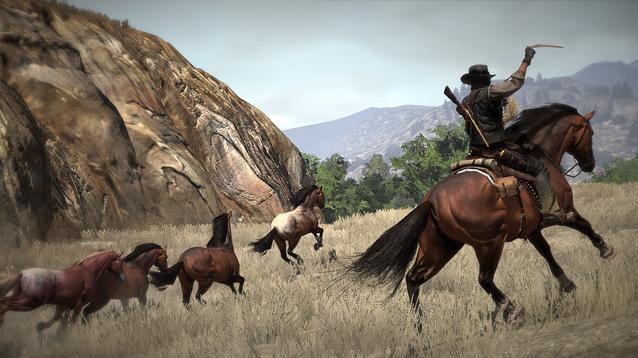
Meanwhile, other games juxtapose the interactivity of the media with a lack of any real capacity to influence the game's story, to significant emotional effect.  "Modern Warfare 2," had the controversial "No Russian" mission, in which the player was forced to massacre civilians in an airport.  And "Red Dead Redemption," leads players toward an unavoidable narrative resolution, despite its open game-world.  Hitchcock was concerned with the ways in which media makes viewers or readers complicit in the acts of characters, and I think he would have found the possibilities of these games fascinating.

At the same time, the artistic aspirations of games are necessarily undercut by structural concerns.  A game is expensive; new Playstation and Xbox games cost $60, so players expect a certain longevity to the experience.  This leads stories to become distended; narrative pacing is slack because value is perceived in length, and players can leave the narrative behind to embark on digressive side-missions or free-roaming.  The conventions of the form require numerous, often repetitive shootouts or car chases.

Monday, December 20, 2010

Wednesday, December 1, 2010

A short primer on introducing a character and a setting

Check this out; it's the intro cinematic to a video game called Fable 3. Impressive short-form storytelling, with no words. You immediately get a sense of this environment and this character trying to persevere against the hopelessness of his plight


Who says video games aren't art?